

If you’re asking can you sue someone for emotional distress, the answer is yes in some circumstances. Hurt feelings alone usually are not enough. You generally need a recognized legal theory, serious harm, causation, and proof that meets your state’s rules.
Yes, U.S. law can allow a civil claim when another person intentionally, recklessly, or negligently causes serious psychological harm. The legal path depends on the conduct, the severity of the harm, and state law. Strong cases usually need evidence connecting the defendant’s conduct to substantial, documented suffering.
| Issue | What it usually means |
|---|---|
| Intentional conduct | Intentional infliction of emotional distress (IIED) may apply to extreme, outrageous conduct that causes severe mental suffering. |
| Negligent conduct | Negligent infliction of emotional distress (NIED) rules vary sharply by state and may require foreseeability, danger, or physical effects. |
| Physical injury | It is not always required, but some states impose physical-impact, symptom, or related limits. |
| Proof | Medical records, therapy records, witnesses, messages, work records, and contemporaneous notes can support causation and severity. |
| Damages | Possible recovery can include treatment costs, lost income, and non-economic harm, subject to state law. |
| Deadline | The filing period depends on the state, claim, defendant, and facts, so there is no single national deadline. |
Key Takeaways
- Serious psychological harm can support a civil case, but ordinary stress or offense usually cannot.
- IIED usually focuses on outrageous intentional or reckless conduct, while NIED depends heavily on state negligence rules.
- Mental suffering may also be recoverable as damages within another claim, such as an accident case.
- Physical injury is not universally required, although some jurisdictions impose physical-impact or symptom requirements.
- Documentation, causation, state deadlines, and possible defenses can determine whether a claim survives.
This article gives general U.S. legal information, not advice for a specific case. State rules can change the elements, defenses, deadlines, and available damages. A lawyer licensed in your state can apply those rules to your facts.
When U.S. Law Recognizes Serious Mental Harm
Psychological harm can appear in two different legal roles. It may form the basis of a standalone tort claim. It may also be a compensable loss within another claim, such as negligence, assault, or a vehicle injury case.
That distinction matters because a person may recover distress damages without proving a separate distress tort. For example, an injured crash victim may seek non-economic damages tied to the underlying negligence claim. Lawzoria’s car wreck claims guide explains how accident damages can include mental suffering.
Two Main Legal Paths: IIED and NIED
Intentional Conduct and IIED
IIED generally addresses conduct intended to cause severe mental harm or undertaken with reckless disregard. Courts usually require behavior that is extreme or outrageous, not merely rude. The plaintiff must also connect that conduct to severe psychological suffering.
- Extreme or outrageous conduct
- Intent or reckless disregard
- Severe mental suffering
- Causation linking the conduct to the harm
Cornell’s Legal Information Institute describes these general elements, while warning that jurisdictions differ. Context can affect whether conduct is legally outrageous. Speech-based claims can also face constitutional limits when protected expression is involved.
Negligent Conduct and NIED
NIED concerns serious mental harm caused by negligence rather than deliberate misconduct. States do not follow one uniform test. Some focus on foreseeability, while others use danger-zone, physical-impact, physical-symptom, or bystander rules.
California shows why national summaries need caution. Its 2026 civil jury instructions treat negligent mental-harm recovery through negligence doctrine rather than a separate tort label. If the harm followed a crash, Lawzoria’s distracted driving attorney guide gives useful context on proving negligence.
Can You Sue Someone for Emotional Distress Without Physical Injury?
A physical injury is not always required in the United States. IIED can sometimes proceed based on severe psychological injury alone. NIED is more state-dependent, and some jurisdictions still require physical impact, symptoms, or another limiting condition.
The absence of bodily injury often makes proof more important, even when the law permits the claim. Treatment records can document symptoms, duration, and functional changes. Witnesses and contemporaneous records can help show that the harm was substantial rather than brief.
What Evidence Can Help Prove Serious Psychological Harm?
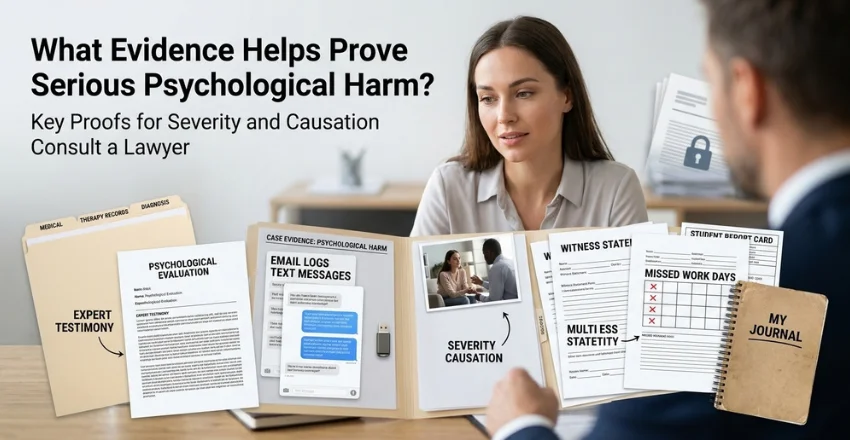
Evidence should show both severity and causation. A diagnosis can be helpful, but it is not the only possible proof. Consistent records created near the time of the events often make the timeline easier to understand.
- Medical, counseling, or therapy records.
- Psychological evaluations or expert testimony.
- Texts, emails, recordings, photographs, or videos showing the defendant’s conduct.
- Witness statements describing changes in sleep, behavior, work, or relationships.
- Employment or school records showing missed time or reduced functioning.
- A contemporaneous journal recording symptoms and significant events.
Mental health records can become sensitive evidence during litigation. Do not assume every private record must be shared voluntarily. A lawyer can explain discovery duties, privileges, authorizations, and how your jurisdiction handles protected information.
What Damages May Be Available?
Compensation depends on the underlying claim and the law of the state hearing it. Economic losses can include counseling costs and lost income when supported by evidence. Non-economic damages may address serious mental suffering and reduced enjoyment of life.
Punitive damages may be available in some cases involving especially wrongful intentional conduct. State law may restrict punitive awards or cap certain non-economic damages, especially in specific case types. There is no reliable nationwide dollar amount for a distress claim.
Accident-related cases often combine physical, financial, and psychological losses in one damages analysis. Lawzoria’s personal injury guide provides a California-focused example of that approach. Its discussion is location-specific, so other states may apply different standards.
How State Law Can Change the Result
State law can change the elements, proof requirements, available defenses, and damages. Bystander claims are one example because states use different relationship and presence rules. Some jurisdictions also distinguish direct victims from people who witnessed harm to someone else.
A fatal event can create separate wrongful-death rights in addition to possible mental-harm issues. Lawzoria’s wrongful death litigation guide explains how those claims differ from criminal cases. Eligibility and recoverable losses still depend on the applicable state statute.
Constitutional rules can matter when a case is based on speech. In Snyder v. Phelps, decided in 2011, the U.S. Supreme Court held 8 to 1 that speech on matters of public concern was shielded from IIED liability. Offensive words are therefore not automatically actionable simply because they cause real pain.
Examples of Claims That May Be Stronger or Weaker
| Situation | Why it may matter | Main caution |
|---|---|---|
| Repeated credible threats causing severe, documented trauma | May support intentional or reckless misconduct | The conduct still must meet the state’s legal threshold |
| A dangerous near-miss followed by serious trauma symptoms | May fit an NIED theory in some states | Danger-zone or physical-effect rules may apply |
| Witnessing a close relative suffer catastrophic injury | Some states recognize bystander recovery | Relationship, presence, and awareness rules differ |
| Ordinary insults, criticism, or a painful breakup | Usually lacks the required legal severity | Other claims could exist if separate unlawful conduct occurred |
| Public criticism involving protected speech | First Amendment protections may limit liability | The facts and public-concern context matter |
The same event can produce different results across states. Courts also examine context, duration, vulnerability, and the defendant’s knowledge. A chart can identify issues, but it cannot determine whether a specific case is legally viable.
What to Do Before Filing a Lawsuit
Early steps should focus on health, evidence, and deadlines rather than confrontation. Preserve information before messages disappear or memories fade. Avoid exaggerating symptoms because credibility can become central to the case. Elsewhere on the site: Severance Definition.
- Seek appropriate medical or mental health care for significant symptoms.
- Save messages, recordings, photographs, incident reports, and witness contact information.
- Record dates, symptoms, missed work, treatment, and major changes in daily functioning.
- Identify the possible legal theory and the state law that may govern it.
- Check the filing deadline before negotiating informally or waiting for symptoms to improve.
Do not secretly record conversations unless you know the recording law that applies. Consent rules vary by jurisdiction, and unlawful recording can create new problems. An attorney can suggest lawful ways to preserve evidence in your state.
How Long Do You Have to Sue?
There is no single U.S. statute of limitations for these cases. The deadline can depend on the state, underlying tort, defendant, discovery rules, and special circumstances. Claims involving government entities may also have shorter notice requirements before a lawsuit.
Do not rely on a generic statement that you always have two or three years. A deadline can expire while treatment or settlement discussions continue. Checking the controlling statute early can prevent an otherwise viable claim from becoming time-barred.
Protect Your Evidence and Check State Law Early
A viable case usually needs more than proof that another person behaved badly. You need a legal theory, serious harm, causation, admissible evidence, and a timely filing. If the harm is substantial, consider discussing the facts with a licensed attorney in the relevant state.
Frequently Asked Questions
Can you sue someone for emotional distress if they never touched you?
Yes, physical contact is not always required. An IIED claim can sometimes rest on extreme conduct that causes severe psychological injury. Negligence-based recovery without bodily injury depends more heavily on the law of the state.
Do you need a diagnosis to bring a claim?
A diagnosis is not a universal legal requirement. Still, professional records can help prove severity, duration, treatment, and causation. Other evidence can include witnesses, work records, communications, and a consistent symptom history.
How much money can you recover for mental suffering?
There is no standard settlement or verdict amount. Value depends on severity, duration, treatment costs, lost income, credibility, and the governing law. Damage caps or insurance limits can also affect the practical recovery.
Can hurt feelings or stress alone support a lawsuit?
Ordinary offense, embarrassment, frustration, or temporary stress usually will not satisfy a severe-harm standard. The defendant also needs a legally recognized basis for liability. A painful experience is not automatically a compensable civil wrong.
Can an employer, business, or institution be liable?
Sometimes, but liability depends on the underlying legal duty and relationship. Employment, medical, premises, civil-rights, and agency rules can create different paths. Workers’ compensation or other statutes may also limit or replace certain tort claims.

