Real estate disputes are complex, high-stakes cases involving substantial financial investments and property rights. In such situations, a real estate litigation attorney protects clients by handling disputes that cannot be resolved through informal negotiation or agreement.
These professionals handle disputes involving property ownership, contract breaches, construction issues, landlord-tenant conflicts, and real estate fraud. They review contracts, gather evidence, and apply property laws to build strong strategies that protect their clients’ interests.
Moreover, a real estate litigation attorney resolves disputes through negotiation, mediation, arbitration, or litigation to ensure fair outcomes. This guide covers their role, case types, hiring situations, legal process, costs, strategies, and key qualities.
| Section | Key Information |
| Introduction | Real estate disputes involve high financial stakes and require a real estate litigation attorney to handle conflicts that cannot be resolved informally. |
| Role of Attorney | Handles property disputes, contract breaches, construction issues, and real estate fraud while protecting client rights through legal strategies. |
| Core Functions | Reviews contracts, gathers evidence, interprets property laws, and represents clients in negotiation or court. |
| When Needed | Required in cases like contract breaches, ownership conflicts, tenant disputes, construction issues, and real estate fraud. |
| Types of Cases | Includes contractual disputes, title disputes, HOA conflicts, commercial property litigation, and easement disputes. |
| Legal Process | Starts with case evaluation, followed by negotiation, lawsuit filing, discovery, mediation/arbitration, and court judgment enforcement. |
| Costs Involved | Depends on complexity, attorney experience, and location; includes hourly rates, retainers, court fees, and expert charges. |
| Choosing Attorney | Based on experience, reputation, communication, courtroom skills, transparency, and fee structure. |
| Key Qualities | Strong legal expertise, litigation experience, negotiation skills, analytical thinking, communication, and attention to detail. |
| Resolution Strategies | Includes negotiation, mediation, arbitration, early case assessment, pre-trial conferences, and full litigation if needed. |
| Final Outcome | The aim is fair resolution, protection of property rights, reduced financial loss, and effective legal representation. |
Understanding the Role of a Real Estate Litigation Attorney

A real estate litigation attorney plays a crucial role in resolving legal disputes arising from property-related matters. Their primary responsibility is to represent clients when real estate conflicts cannot be resolved through negotiation or informal agreement.
A real estate litigation attorney handles disputes involving property ownership, contract breaches, construction issues, and real estate fraud. Unlike transactional lawyers, they become involved when conflicts require legal action or court resolution.
They review contracts, gather evidence, interpret property laws, and develop robust legal strategies to protect their clients. Whether through mediation or court, a real estate litigation attorney ensures their client’s rights are protected and a fair resolution is achieved.
When Do You Need a Real Estate Litigation Attorney?
Hiring a real estate litigation attorney becomes necessary when disputes escalate beyond informal resolution.
Breach of Property Contract
- If a buyer, seller, or developer fails to fulfill contractual obligations, legal intervention is required.
Property Ownership Conflicts
- Disputes over inheritance, unclear titles, or multiple claims on the same property.
Tenant and Landlord Disputes
- Issues such as eviction, unpaid rent, illegal occupancy, or lease violations.
Construction Disputes
- Delays, poor artistry, or disagreements with contractors.
Real Estate Fraud
- Misrepresentation of property condition, forged documents, or hidden defects.
Types of Real Estate Litigation Cases
A real estate litigation attorney handles a wide variety of cases depending on property laws and jurisdiction.
Contractual Disputes
- These arise when parties’ agreements are violated or misinterpreted.
Title Disputes
- Issues related to unclear ownership records or defective property titles.
HOA (Homeowners Association) Conflicts
- Disputes over community rules, fees, or property usage restrictions.
Commercial Property Litigation
- Disputes involving business properties, leases, or investment agreements.
Easement and Access Disputes
- Conflicts over the right to use another person’s land for access or utilities.
Legal Process Followed by a Real Estate Litigation Attorney
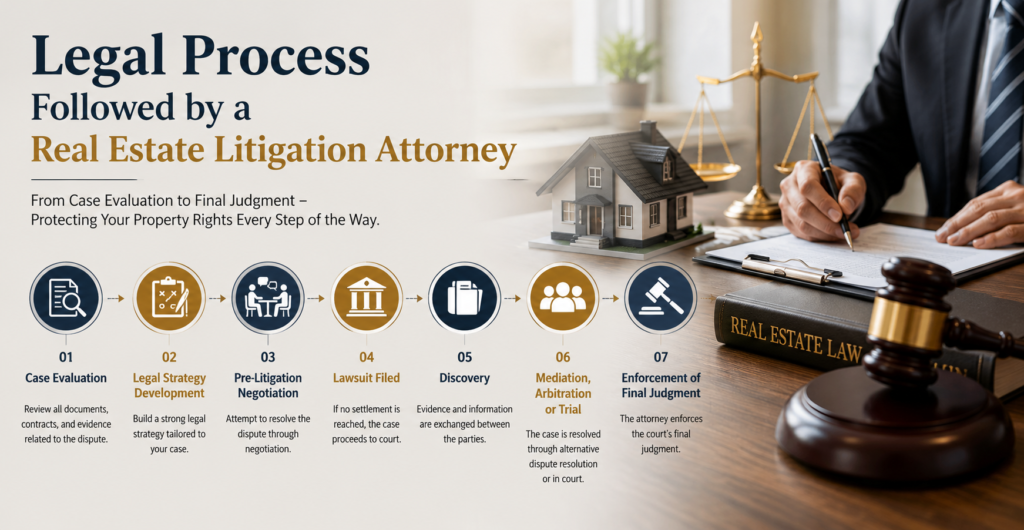
The legal process begins with a detailed case evaluation, where the attorney reviews all documents, contracts, and evidence related to the dispute. They then develop a legal strategy and often attempt pre-litigation negotiation to resolve the issue without going to court.
If a settlement fails, the case proceeds to a lawsuit, followed by discovery, during which evidence is exchanged between the parties. It may then go to mediation, arbitration, or trial, and the attorney enforces the court’s final judgment.
Costs Involved in Hiring a Real Estate Litigation Attorney
The cost of hiring a real estate litigation attorney depends on factors like case complexity, evidence, attorney experience, and location. They usually charge by the hour, offer flat fees for simpler cases, or require a retainer that is billed as the case progresses.
Complex real estate litigation increases costs due to longer court processes, investigations, expert consultations, and additional legal fees. However, hiring an experienced attorney is often beneficial as it helps protect property rights and improves case outcomes.
How to Choose the Best Real Estate Litigation Attorney

Choosing the best real estate litigation attorney depends on their experience, reputation, and focus on property dispute cases. They should have a strong record in handling issues such as contract breaches and fraud, along with solid knowledge of local property laws.
It is also important to assess their negotiation and courtroom skills, as effective representation often depends on both settlement ability and trial performance. Clients should review client testimonials and professional credentials to understand the attorney’s reliability and success rate.
Firstly, Clear communication, responsiveness, transparency, and a clear fee structure are essential when choosing a real estate litigation attorney. The best attorney combines strong legal expertise and strategic thinking to protect your interests and achieve the best possible outcome.
Qualities of a Skilled Real Estate Litigation Attorney
- Strong legal expertise in real estate laws, contracts, and litigation procedures
- Proven litigation experience in handling property disputes and court cases
- Excellent negotiation skills for effective settlement and mediation
- Strong analytical thinking to evaluate complex legal documents and issues
- Effective communication to explain strategies and keep clients informed
- Attention to detail when reviewing contracts, evidence, and legal paperwork
Resolution Strategies Used in Real Estate Litigation

In real estate litigation, attorneys use different strategies to resolve disputes while protecting clients’ legal and financial interests. The most common is negotiation, in which both parties reach a settlement through direct discussion or through their attorneys, without going to court.
Mediation involves a neutral third party who helps both sides communicate and reach a fair settlement. In arbitration, an arbitrator reviews the evidence and issues a binding or non-binding decision in accordance with the agreement.
Attorneys use early case assessment and pre-trial conferences to evaluate cases and encourage settlement. If unresolved, the case proceeds to trial for a final judgment, helping reduce costs, delays, and stress.
Conclusion
A real estate litigation attorney helps resolve complex property disputes while protecting clients’ legal and financial interests. They handle issues such as contract breaches, ownership conflicts, landlord-tenant disputes, boundary disputes, and real estate fraud.
They guide clients through negotiation, mediation, arbitration, and courtroom litigation to achieve fair and lawful outcomes. Their expertise in property law, evidence analysis, and case strategy helps reduce risks, minimize financial losses, and improve success in dispute resolution.
Ultimately, by understanding their responsibilities, legal processes, costs, resolution strategies, and essential qualities, individuals can make informed decisions and choose the right attorney to effectively protect their property interests and achieve justice in real estate conflicts.
If you want to read an interesting article about it, explore our Real Estates category.
FAQs
The highest-paid legal professionals are typically patent attorneys and trial attorneys who handle mass torts or plaintiff personal injuries.
Property-related legal challenges, such as contract violations, ownership disputes, landlord-tenant disputes, construction disputes, and real estate fraud, are handled by a real estate litigation lawyer.
They handle contractual disputes, title disputes, HOA disputes, commercial property disputes, easement issues, and fraud or misrepresentation lawsuits.
The complexity of the case, the attorney’s experience, and the location all affect costs. Hourly rates, retainers, court expenses, and expert witness fees are examples of fees.
Strong legal knowledge, litigation experience, negotiating abilities, transparent communication, and a track record of success in property disputes are all important.