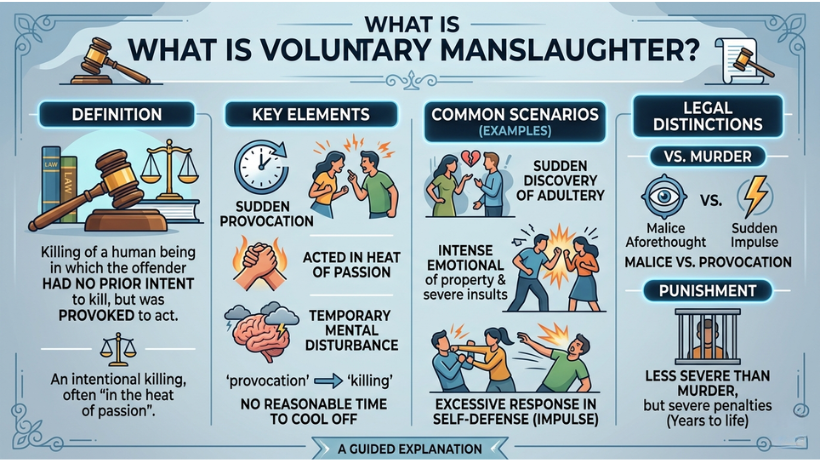
Before diving into legal definitions and criminal classifications, many people ask: what is voluntary manslaughter? And how does it differ from murder? This criminal offense involves the intentional killing of another person under circumstances that reduce moral blame, such as acting in the heat of passion after extreme provocation. Although the act is intentional, the law recognizes that emotions and sudden events can affect human judgment.
Understanding this offense is important because the penalties are severe, and the distinction between manslaughter and murder can dramatically affect sentencing. Knowing the legal elements, examples, and defenses helps explain why courts treat these cases differently.
| Aspect | Voluntary Manslaughter | Murder |
| Definition | Intentional killing caused by sudden provocation or heat of passion | Intentional killing with malice, often involving planning |
| Premeditation | No | Often yes |
| Common Examples | Domestic disputes, sudden fights | Planned attacks, revenge killings |
| Heat of Passion | Present | Usually absent |
| Penalties | Several years to decades in prison, fines | Decades to life imprisonment, possible death penalty |
| Sentencing Factors | Criminal history, weapon use, aggravating circumstances | Premeditation, victim vulnerability, criminal history |
| Legal Defenses | Imperfect self-defense, emotional disturbance | Self-defense, insanity, mistaken identity |
| Long-Term Impact | Permanent felony record, loss of rights | More severe criminal record and consequences |
| Severity | Serious felony, less severe than murder | Most serious homicide offense |
| Key Difference | Killing without prior planning due to provocation | Killing with malice and often premeditation |
Understanding What Is Voluntary Manslaughter?

Voluntary manslaughter is a type of homicide in which a person intentionally causes the death of another but does so under circumstances that reduce the crime from murder. Most commonly, this happens when someone acts in the “heat of passion” after being provoked.
Unlike premeditated murder, there is no planning. Instead, the killing occurs suddenly after an emotional event that would cause a reasonable person to lose self-control.
Common factors include:
- Extreme emotional distress
- Serious provocation
- Lack of prior planning
- Immediate reaction to a triggering event
Key Elements Prosecutors Must Prove
For a conviction, prosecutors generally need to establish several elements:
- The defendant intentionally caused another person’s death.
- There was adequate provocation.
- The act occurred before there was sufficient time to cool down.
- The circumstances do not justify the killing.
Courts evaluate each case carefully because state laws and definitions may vary.
Real-Life Examples of Voluntary Manslaughter

Understanding real-world scenarios helps explain how these cases arise.
Heat of Passion Incident
A person unexpectedly discovers a spouse involved in an affair and immediately reacts violently without time for reflection. Courts may view this as voluntary manslaughter rather than murder, depending on the circumstances.
Sudden Physical Altercation
During an intense argument, one individual attacks another. In response, the victim reacts excessively, causing death. The absence of planning can influence how charges are filed.
Severe Provocation
Repeated threats and an emotionally charged confrontation may lead someone to lose control and commit a fatal act. Legal authorities examine whether a reasonable person could have experienced similar emotional disturbance.
Voluntary Manslaughter vs. Murder

Although both crimes involve intentional killing, important differences exist.
| Factor | Voluntary Manslaughter | Murder |
| Intentional Act | Yes | Yes |
| Premeditation | Usually No | Often Yes |
| Emotional Provocation | Present | Generally Absent |
| Heat of Passion | Common | Rare |
| Severity of Punishment | Lower | Higher |
| Possibility of Reduced Charges | Greater | Limited |
Because intent and circumstances differ, prosecutors and defense attorneys focus heavily on the events leading up to the incident.
Common Causes Behind These Cases

Several situations may trigger emotionally driven actions.
Domestic Conflicts
Arguments involving infidelity, divorce, or family disputes frequently appear in voluntary manslaughter cases.
Physical Assault
A violent confrontation may escalate unexpectedly, resulting in a death without prior planning.
Emotional Distress
Extreme anger, fear, or shock can affect a person’s ability to think rationally, although emotional distress alone does not excuse criminal conduct.
Penalties and Sentencing
People researching what is voluntary manslaughter often want to understand the potential consequences of a conviction. Although penalties vary by state and jurisdiction, they are generally severe and can include prison sentences ranging from several years to decades, substantial fines, and probation in limited circumstances.
The exact sentence depends on several factors, including the defendant’s prior criminal history, whether a weapon was used, the specific circumstances surrounding the offense, applicable state laws, and the presence of aggravating factors.
Courts may impose harsher punishments when the victim was particularly vulnerable, multiple victims were involved, dangerous weapons were used, or the defendant has previous criminal convictions. These circumstances can significantly increase the severity of the sentence and affect parole eligibility and other long-term consequences.
Legal Defenses Used in Voluntary Manslaughter Cases
Defense attorneys often challenge the prosecution’s claims or seek reduced charges.
Imperfect Self-Defense
A person may genuinely believe deadly force was necessary, even if that belief was unreasonable. Some jurisdictions recognize this defense and reduce murder charges.
Lack of Intent
Attorneys may argue that the death resulted from negligence rather than intentional conduct.
Insufficient Evidence
If prosecutors cannot prove all required elements beyond a reasonable doubt, charges may be reduced or dismissed.
Mental or Emotional Disturbance
Evidence showing severe emotional stress may influence the outcome or sentencing.
Why the Difference Matters
The distinction between manslaughter and murder can affect every aspect of a case.
Major consequences include:
- Length of prison sentence
- Eligibility for parole
- Criminal record implications
- Employment opportunities after release
- Social stigma and reputation
Because homicide laws are complex, legal representation is critical for both defendants and victims’ families.
Steps Followed During a Criminal Case
Investigation
Police gather witness statements, forensic evidence, and surveillance footage.
Filing of Charges
Prosecutors decide whether murder or manslaughter charges are appropriate.
Court Proceedings
Defense lawyers and prosecutors present evidence before a judge or jury.
Sentencing
If convicted, the court determines punishment based on applicable laws and aggravating factors.
Important Facts to Remember

- Voluntary manslaughter is an intentional killing committed under circumstances involving provocation.
- It differs from murder because premeditation is usually absent.
- Penalties are severe despite reduced culpability.
- State laws vary considerably.
- Legal defenses may affect charges and sentencing.
Conclusion
Understanding what is voluntary manslaughter helps clarify one of the most misunderstood areas of criminal law. While the offense involves intentional killing, courts recognize that sudden provocation and emotional circumstances can distinguish it from murder. Real-life examples, sentencing guidelines, and legal defenses demonstrate why these cases require careful analysis.
Because the consequences can include lengthy prison terms and lifelong criminal records, anyone involved in such a case should seek qualified legal advice. Recognizing the differences between murder and voluntary manslaughter provides a better understanding of how the justice system evaluates intent, emotion, and responsibility.
Want to know about The Ultimate Driver’s Guide to I-Ticket Law and How It Can Affect Your License, Insurance Rates, Financial Stability, and Future Driving Privileges Check out our Legal Advice category.
FAQs
No. Although both involve intentional killing, voluntary manslaughter generally occurs under circumstances involving adequate provocation and lacks premeditation.
Heat-of-passion incidents involving sudden emotional reactions during domestic disputes are among the most common examples.
Sentences vary by jurisdiction, but prison terms can range from several years to decades depending on the circumstances.
Yes. Defense attorneys may argue self-defense, lack of intent, or insufficient evidence, which can affect the outcome.