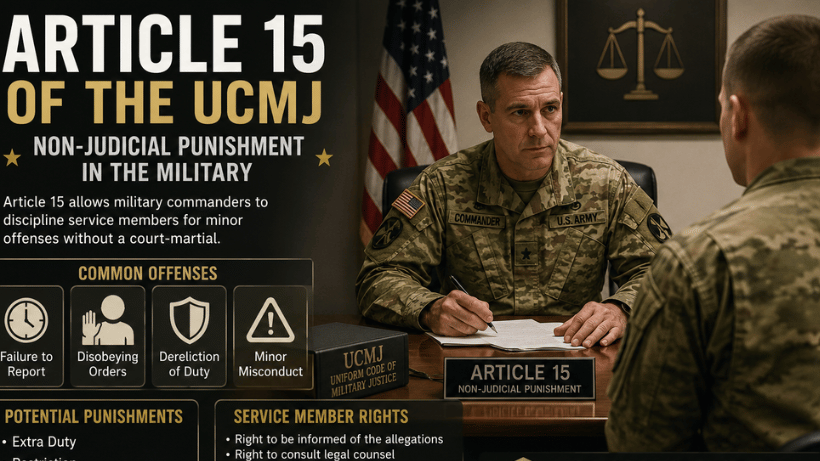
Article 15 Military of the Uniform Code of Military Justice (UCMJ) is a vital component of the military justice system designed to maintain discipline, order, and accountability within the United States Armed Forces. Unlike formal criminal proceedings such as court-martials, Article 15 authorizes commanders to address minor offenses through Non-Judicial Punishment (NJP).
This system plays a crucial role in ensuring that military standards are upheld while still allowing service members an opportunity for rehabilitation rather than harsh legal punishment. Understanding Article 15 is essential for every service member, as it directly impacts conduct, career progression, and overall military standing.
| Section | Key Points |
| What Is Article 15 | A commander-led disciplinary process for minor offenses under UCMJ focuses on correction and accountability. |
| History | Established in 1950 under UCMJ to standardize military justice across all U.S. armed forces. |
| Who Can Receive | Any active-duty member of the Army, Navy, Air Force, Marine Corps, Coast Guard, or Space Force. |
| Common Offenses | Failure to report, disobeying orders, dereliction of duty, and minor misconduct. |
| Failure to Report | Missing duty, formation, or appointment without authorization. |
| Disobeying Orders | Refusing or ignoring lawful orders from superiors. |
| Dereliction of Duty | Failing to perform assigned responsibilities properly. |
| Minor Misconduct | Less serious violations that affect discipline but do not require a court-martial. |
| Article 15 Process | Includes investigation, notification, and rights explanation before action is taken. |
| Can You Refuse? | Yes, a service member may request a court-martial but risks harsher punishment. |
| Rights of Member | Right to counsel, evidence review, defense presentation, and appeal. |
| Appeals Process | Punishment can be appealed and reviewed by higher authority. |
| Impact on Career | Can affect rank, promotion, security clearance, and reenlistment. |
| Legal Representation | Legal counsel helps protect rights and improve case outcomes. |
What Is Article 15 Military?
Article 15 is a disciplinary procedure under the Uniform Code of Military Justice (UCMJ) that allows military commanders to address minor offenses committed by service members without conducting a formal court-martial. Often referred to as Non-Judicial Punishment (NJP), Article 15 authorizes commanders to investigate misconduct and impose appropriate penalties when necessary.
Article 15 Military: This process is designed to handle less serious violations efficiently while preserving military discipline and readiness. Common offenses that may lead to an Article 15 include failure to report for duty, disobeying lawful orders, disrespect toward superior officers, and other minor breaches of military regulations.
History of Article 15
The Uniform Code of Military Justice was enacted in 1950 to establish a standardized legal system for all branches of the U.S. Armed Forces. Article 15 was included to provide commanders with an effective way to discipline service members for less serious violations. Over the years, Article 15 has remained a fundamental component of military justice because it balances the need for discipline with the rights of military personnel.
Who Can Receive an Article 15?
Any active-duty military member subject to the UCMJ may receive an Article 15 if they are suspected of committing a minor offense. This includes members of the following:
- Army
- Navy
- Air Force
- Marine Corps
- Coast Guard
- Space Force
The commander determines whether the alleged misconduct is appropriate for Article 15 proceedings or should instead be referred to a court-martial.
Common Offenses Leading to Article 15
Failure to Report
Failure to report is one of the most common military offenses that can lead to disciplinary action under Article 15. This violation occurs when a service member fails to appear at a scheduled duty assignment, formation, training exercise, meeting, or military appointment at the required time and place without proper authorization.
Disobeying Orders
Disobeying orders is another serious offense that may result in an Article 15 punishment. Military service is built upon a strict chain of command, and service members are expected to follow lawful orders issued by superior officers and noncommissioned officers.
Dereliction of Duty
Dereliction of duty occurs when a service member fails to perform assigned responsibilities properly, either through negligence, carelessness, or willful disregard of their obligations. Every military position carries specific duties essential to mission success, personnel safety, and overall unit effectiveness.
Minor Misconduct

Minor misconduct refers to less serious violations of military rules and regulations that negatively affect good order and discipline but do not rise to the level of requiring a court-martial. These offenses can include inappropriate behavior, failure to follow routine procedures, disorderly conduct, and short-duration unauthorized absences.
The Article 15 Process
Investigation
- The first step in the Article 15 process.
- The commander reviews the alleged offense.
- Evidence and relevant facts are gathered.
- Witness statements may be collected and examined.
- The circumstances surrounding the incident are evaluated.
Notification
- The commander explains the proposed Article 15 action.
- The service member is notified of their legal rights.
- Information about the evidence may be made available.
- The accused is allowed to respond to the allegations.
- Ensures transparency and fairness in the disciplinary process.
- Allows the service member to prepare a defense if necessary.
Rights Explanation
- The service member is informed of all legal rights.
- The accused has the right to consult with legal counsel.
- The right to review the evidence against them is explained.
- The service member may present witnesses and supporting evidence.
- The right to make a personal statement is provided.
Can a Service Member Refuse an Article 15?
Yes, in many situations, a service member has the right to refuse Article 15 proceedings and request that the case be handled through a court-martial instead. This option allows the accused individual to have the allegations reviewed in a formal military court where additional legal protections and procedures are available.
However, choosing a court-martial is a significant decision because, if found guilty, the service member may face more severe penalties than those typically imposed under Article 15 non-judicial punishment. For this reason, service members are strongly encouraged to carefully evaluate the evidence.
Rights of Service Members Under Article 15
Military personnel accused of misconduct retain important rights during Article 15 proceedings:
- Right to be informed of the allegations.
- Right to review supporting evidence.
- Right to consult legal counsel.
- Right to present evidence and witnesses.
- Right to make a personal statement.
- Right to appeal the punishment.
Appeals Process
A service member who believes the punishment was unjust or disproportionate may file an appeal through military channels. Appeals generally must be submitted within a specific timeframe after punishment is imposed. Higher-ranking authorities review the case and determine whether the punishment should be reduced, suspended, or overturned.
Impact of an Article 15 on a Military Career
Although Article 15 is not a criminal conviction, it can still have long-term consequences, including:
- Negative performance evaluations.
- Reduced promotion opportunities.
- Loss of leadership positions.
- Security clearance concerns.
- Potential impact on reenlistment eligibility.
The extent of these consequences varies depending on the seriousness of the offense and the service member’s overall record.
Importance of Legal Representation

While Article 15 proceedings are less formal than court-martials, legal advice remains extremely important. Military defense attorneys can help service members understand their rights, evaluate evidence, prepare defenses, and determine whether to accept an Article 15 or request a court-martial.
Proper legal guidance can significantly influence the outcome of an Article 15 proceeding and help protect a service member’s military career. Experienced military defense attorneys understand the complexities of military law and can assist in reviewing evidence, identifying potential defenses, preparing statements, and ensuring that the service member’s rights are protected.
Conclusion
Article 15 of the UCMJ serves as a balanced and effective disciplinary tool that helps maintain order within the military while protecting the rights of service members. It addresses minor violations swiftly, promotes accountability, and encourages corrective behavior without resorting to formal court proceedings.
Article 15 Military: However, despite being nonjudicial in nature, an Article 15 can still have serious implications for a service member’s career, including rank reduction, loss of pay, and long-term professional consequences. Therefore, understanding the process, knowing one’s rights, and seeking proper legal guidance when necessary is essential.
Want to know about Voluntary Manslaughter Sentence: All You Need To Know About Average Sentence, Key Factors, State Differences, and More Check out our Criminal Law category.
FAQs
Article 15 of the UCMJ is a non-judicial punishment process that allows military commanders to discipline service members for minor offenses without going to a court-martial. It is used to correct behavior and maintain good order and discipline.
Yes, it can impact your career even though it is not a criminal conviction. It may affect promotions, performance evaluations, leadership opportunities, security clearances, and reenlistment eligibility depending on the severity of the offense.
In some cases, yes. A service member may refuse Article 15 and request a court-martial instead. However, this can be risky because a court-martial may result in more severe punishment if found guilty.
Possible punishments include extra duty, restriction, reduction in rank, forfeiture of pay, and formal reprimands. The severity depends on the offense and the commander’s decision.
While not always required, legal representation is strongly recommended. A military defense attorney can help protect your rights, review evidence, and guide you in deciding whether to accept an Article 15 or request a court-martial.