

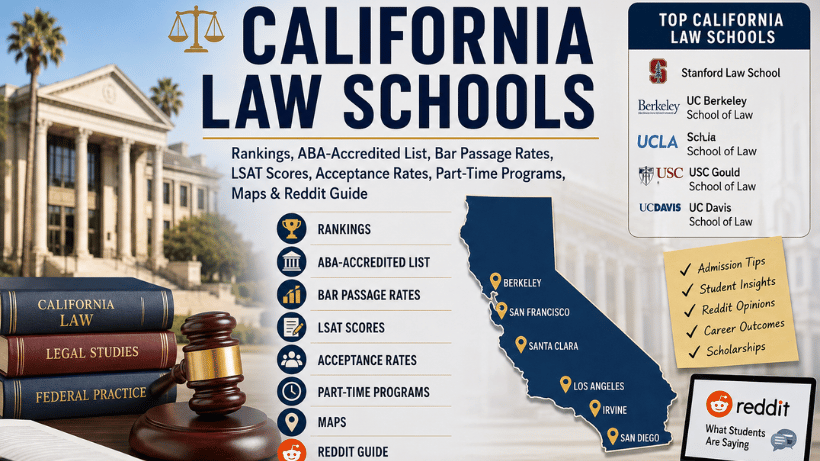
Choosing the right California law school is one of the most important decisions for aspiring attorneys. Home to some of the nation’s highest-ranked and most respected law schools, California offers a wide range of options for students pursuing careers in corporate, technology, entertainment, public interest, and criminal law.
Whether you’re comparing ABA-accredited law schools, rankings, bar passage rates, LSAT scores, acceptance rates, part-time JD programs, or alternative admission pathways, understanding these factors can help you make an informed decision.
This guide provides a comprehensive overview of California law schools, including admissions requirements, school rankings, student insights from Reddit, and practical tips for choosing the program that best matches your academic background and career goals.
| Feature | Overview |
| Number of ABA-Accredited California Law Schools | More than 20 |
| Top-Ranked Schools | Stanford, UC Berkeley, UCLA, USC Gould |
| Typical LSAT Score Range | 150–173 |
| Acceptance Rates | Approximately 8% to 45% depending on the school |
| First-Time Bar Passage Rates | Roughly 55% to over 95% |
| Part-Time JD Programs | Available at several California law schools |
| Alternative Pathways | California-accredited schools and the Law Office Study Program |
| Popular Study Locations | Los Angeles, San Francisco Bay Area, San Diego, Irvine, Davis |
Why Study Law in California?
California offers one of the country’s largest legal markets. The state is home to major technology companies, entertainment studios, healthcare organizations, financial institutions, and government agencies that consistently hire attorneys.
Graduates can pursue careers in:
- Corporate law
- Criminal law
- Intellectual property
- Environmental law
- Immigration law
- Family law
- Entertainment law
- Technology law
- Real estate law
- Public interest law
Many California law schools also maintain strong relationships with law firms, government offices, nonprofits, and Fortune 500 companies, providing valuable internship and networking opportunities.
California Law Schools Rankings

California is home to some of the most respected law schools in the United States, offering students a wide range of academic programs, legal clinics, research opportunities, and networking connections. While rankings should not be the sole factor in choosing a law school, they provide valuable insight into academic reputation, faculty excellence, employment outcomes, and bar exam performance.
Here are some of the top-ranked California law schools and what makes each one stand out.
1. Stanford Law School
Stanford Law School is widely regarded as the best law school in California and consistently ranks among the top law schools in the nation. Located in the heart of Silicon Valley, it offers unmatched opportunities in technology law, constitutional law, intellectual property, business law, and public policy.
Admission is highly competitive, with an acceptance rate of roughly 8%, and successful applicants typically have LSAT scores between 170 and 173. Graduates enjoy exceptional employment prospects at prestigious law firms, federal clerkships, government agencies, and Fortune 500 companies.
2. UC Berkeley School of Law
The University of California, Berkeley School of Law is renowned for its strong academic programs, its commitment to public interest law, and its leadership in environmental, technology, and international law. With an acceptance rate around 17%, Berkeley attracts high-achieving applicants from across the country.
Most admitted students have LSAT scores ranging from 168 to 171. The school also offers extensive clinical programs and research opportunities that prepare graduates for successful legal careers.
3. UCLA School of Law
Located in Los Angeles, UCLA School of Law is recognized for excellence in entertainment law, business law, tax law, and critical race studies. Its location provides students with access to major law firms, entertainment companies, and government organizations.
Admission remains highly competitive, with an acceptance rate near 15%. Successful applicants generally present LSAT scores between 166 and 171, along with strong academic records and extracurricular achievements.
4. USC Gould School of Law
USC Gould School of Law combines academic excellence with one of the strongest alumni networks in Southern California. The school is especially well known for business law, dispute resolution, and entertainment law. Students benefit from close relationships with leading employers throughout Los Angeles.
Admission is selective, and applicants typically need LSAT scores in the mid-to-high 160s along with competitive undergraduate GPAs.
5. UC Irvine School of Law
Although relatively young compared to other institutions, UC Irvine School of Law has quickly established itself as one of California’s leading law schools. It is particularly respected for experiential learning, public service, and innovative legal education.
Admission is competitive, with acceptance rates around 18%, and most admitted students have LSAT scores between 164 and 169. Graduates consistently achieve strong employment outcomes and impressive bar passage rates.
6. UC Davis School of Law
UC Davis School of Law offers a collaborative learning environment with strengths in environmental, immigration, public interest, and international law. The school is known for smaller class sizes and personalized faculty support. Its acceptance rate is generally higher than that of California’s most elite schools, making it an attractive option for qualified applicants seeking a highly respected legal education.
7. Pepperdine Caruso School of Law
Located in Malibu, overlooking the Pacific Ocean, Pepperdine Caruso School of Law is recognized for its programs in dispute resolution, mediation, constitutional law, and business law. The school combines rigorous academics with a values-based educational approach and maintains strong employment connections throughout Southern California.
8. Loyola Law School Los Angeles
Loyola Law School has earned a reputation for producing highly skilled trial attorneys and entertainment lawyers. Situated in downtown Los Angeles, the school provides students with convenient access to courts, government agencies, and major law firms. It also offers extensive evening and flexible JD programs, making it a popular choice for working professionals.
9. University of San Diego School of Law
The University of San Diego School of Law is known for its strengths in tax law, intellectual property, international law, and business law. Its location near the U.S.-Mexico border offers unique opportunities in immigration and cross-border legal practice. Students also benefit from a beautiful campus and a supportive academic environment.
10. Santa Clara University School of Law
Located in Silicon Valley, Santa Clara University School of Law is especially respected for its work in technology, privacy, cybersecurity, and intellectual property law. Its close partnerships with leading technology companies provide students with valuable internships, networking opportunities, and career placements in one of the world’s largest innovation hubs.
ABA-Accredited California Law Schools

Most students seeking maximum career flexibility choose an ABA-accredited law school because graduates are generally eligible to sit for the bar examination in every U.S. jurisdiction, subject to local rules.
Some of California’s ABA-accredited law schools include:
- Stanford Law School
- UC Berkeley School of Law
- UCLA School of Law
- USC Gould School of Law
- UC Irvine School of Law
- UC Davis School of Law
- Pepperdine Caruso School of Law
- Loyola Law School
- University of San Diego School of Law
- Santa Clara University School of Law
- Chapman University Fowler School of Law
- California Western School of Law
- Southwestern Law School
- Golden Gate University School of Law
- University of San Francisco School of Law
- Western State College of Law
Choosing an ABA-accredited school is especially important for students who may wish to practice outside California in the future.
Understanding Bar Passage Rates
One of the most important statistics to review is a school’s bar passage rate. The California Bar Examination is widely considered one of the most challenging in the country. Schools with consistently high first-time pass rates often provide strong academic support, bar preparation programs, and rigorous legal training.
Typical First-Time Bar Passage Performance
- Top Schools: Typically achieve 85–95% or higher first-time bar passage rates.
- Strong Regional Schools: Usually report 70–85% first-time pass rates.
- Mid-Level Schools: Generally have bar passage rates between 55 and 70%.
- Lower-Performing Schools: Often record first-time pass rates below 55%.
These figures are approximate and may vary from year to year based on each school’s graduating class and California Bar Exam results. A high bar passage rate generally indicates that graduates are well-prepared for legal practice. However, applicants should consider this statistic alongside tuition costs, employment rates, and career goals rather than relying on it alone.
LSAT Scores Required
The Law School Admission Test (LSAT) remains one of the most influential factors in law school admissions, although some schools also accept the GRE. Competitive California schools usually expect stronger LSAT scores.
| School Category | Typical LSAT Range |
| Elite Schools | 170–173 |
| Highly Competitive | 165–170 |
| Strong Regional Schools | 158–165 |
| Accessible Schools | 150–158 |
Applicants with lower LSAT scores may still receive admission by demonstrating:
- Strong undergraduate GPA
- Significant work experience
- Leadership activities
- Exceptional personal statements
- Diversity of experience
- Graduate degrees
Admissions committees increasingly evaluate candidates holistically rather than relying solely on standardized test scores.
Acceptance Rates

Acceptance rates vary significantly across California law schools.
Highly Selective Schools
The most competitive law schools in California include Stanford Law School, UCLA School of Law, USC Gould School of Law, and UC Berkeley School of Law. These prestigious institutions often admit fewer than 20% of applicants and typically look for exceptional academic records, high LSAT scores, strong personal statements, and meaningful extracurricular achievements.
Moderately Competitive Schools
Schools such as UC Davis School of Law, UC Irvine School of Law, Pepperdine Caruso School of Law, Loyola Law School Los Angeles, and the University of San Diego School of Law are considered moderately competitive.
Their acceptance rates generally range from 20% to 45%, making them attractive options for students seeking a respected legal education with slightly more accessible admissions standards.
More Accessible Schools
Several California law schools admit a larger percentage of applicants while still offering quality legal education and strong local employment opportunities. Applicants should remember that acceptance rates fluctuate annually depending on applicant volume and class size.
Factors Beyond Rankings
Many applicants focus exclusively on rankings, but successful law students also evaluate the following:
- Employment outcomes
- Tuition costs
- Scholarship availability
- Faculty accessibility
- Clinical programs
- Internship opportunities
- Alumni network
- Geographic location
- Specializations
- Campus culture
For example, a student interested in entertainment law may benefit more from attending a Los Angeles-based school than a higher-ranked institution elsewhere.
California Law Schools with Part-Time Programs
Many California law schools offer part-time or evening JD programs for students who want to work while earning a law degree. These programs typically take four years instead of three and award the same JD degree as full-time programs.
Popular schools with part-time options include:
- Loyola Law School Los Angeles – Well-known evening JD program.
- Southwestern Law School – Flexible evening and accelerated schedules.
- Santa Clara University School of Law – Ideal for professionals in Silicon Valley.
- University of San Francisco School of Law – Flexible scheduling for working students.
When comparing part-time programs, consider:
- Tuition and scholarships
- Class schedules
- Bar passage rates
- Internship opportunities
- Employment outcomes
California Law Schools That Don’t Require a Bachelor’s Degree

Most ABA-accredited law schools require applicants to hold a bachelor’s degree before admission. However, California offers a few alternative pathways for individuals who do not meet this traditional requirement. Some California-accredited or registered law schools may consider applicants who have completed sufficient college coursework in lieu of a four-year bachelor’s degree, although admission policies vary by institution.
Another unique option is the Law Office Study Program, which allows eligible individuals to study law under the supervision of a licensed attorney or judge instead of attending a traditional law school. While these alternatives can provide a path to becoming a lawyer, they may limit opportunities to practice law outside California.
Before pursuing either option, prospective students should carefully verify admission requirements and bar eligibility with both the law school and the California State Bar to ensure the pathway aligns with their long-term career goals.
California Law School Map
California law schools are located throughout the state.
Northern California
- Stanford Law School
- UC Berkeley School of Law
- UC Davis School of Law
- Santa Clara University School of Law
- University of San Francisco School of Law
Southern California
- UCLA School of Law
- USC Gould School of Law
- Loyola Law School
- Pepperdine Caruso School of Law
- UC Irvine School of Law
- University of San Diego School of Law
- Southwestern Law School
- Chapman University Fowler School of Law
Choosing a school near your preferred practice area can improve internship and networking opportunities.
Reddit Guide: What Students Say
Many prospective students turn to Reddit to gain insight into the real experiences of current law students and graduates. While opinions vary, several common themes emerge across discussions. Stanford Law School and UC Berkeley School of Law are frequently praised for their exceptional academics, distinguished faculty, and career opportunities, although students often mention their rigorous workloads and competitive environments.
UCLA School of Law is widely recommended for those interested in entertainment law due to its strong industry connections in Los Angeles. USC Gould School of Law is regularly recognized for its influential alumni network and excellent employment opportunities, while Santa Clara University School of Law is highly regarded for technology, intellectual property, and cybersecurity law because of its proximity to Silicon Valley.
Across Reddit discussions, one piece of advice appears consistently: applicants should consider scholarships, bar passage rates, employment outcomes, and expected student debt alongside rankings when choosing the right California law school.
Tips for Choosing a California Law School

Before applying, compare:
- ABA accreditation
- Bar passage rates
- Acceptance rates
- Median LSAT and GPA
- Tuition and scholarships
- Employment statistics
- Clinical programs
- Part-time options
- School location
- Alumni network
The best law school is one that aligns with your career goals and budget.
Conclusion
Choosing the right California law school requires careful research and planning. California offers some of the nation’s finest legal education opportunities, with programs ranging from elite ABA-accredited law schools to flexible part-time JD programs and unique alternative pathways into the legal profession.
Whether your goal is to attend a nationally ranked California law school like Stanford or Berkeley or enroll in a regional institution that fits your budget and career goals, there are excellent options across the state. Before making your final decision, compare California law school rankings, bar passage rates, LSAT score requirements, acceptance rates, tuition costs, scholarship opportunities, employment outcomes, and campus locations.
By evaluating these factors, you can select the California law school that best prepares you for a successful legal career.
Want to know about Traffic Court Lawyer Explained: 10 Ways a Skilled Attorney Can Fight Tickets, Reduce Fines, and Protect Your Driving Record Check out our Find A Lawyer category.
Frequently Asked Questions
Admissions for Law | Golden Gate University. California’s most accessible law schools often have lower median LSAT scores (between 144 and 155) and greater acceptance rates (over 40%).
A 3.3 GPA is considered below the median for many law school admissions programs, which often require GPAs of 3.5 or higher. However, a lower GPA might be offset throughout the admissions process by strong LSAT scores, persuasive personal statements, and relevant experience.
A California law school typically takes three years to complete if you enroll as a full-time student. If you choose a part-time or evening JD program, it usually takes four years to earn your degree. After graduating, you must pass the California Bar Exam and meet other licensing requirements to practice law in the state.
Most ABA schools require one, but some California-approved schools and the Law Office Study Program provide alternative pathways.

