

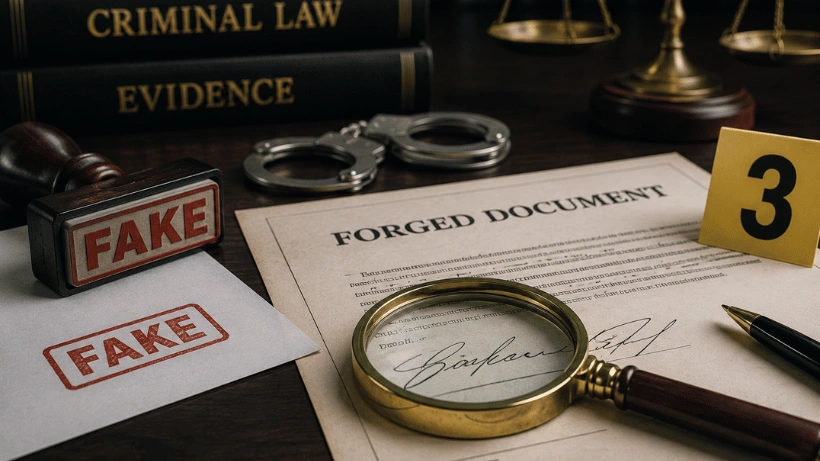
Someone signs a name that is not theirs. Whether that turns into a forgery crime depends on far more than the handwriting. The state has to prove a state of mind, not just a signature that does not match. That gap is where most of these cases are won or lost. Elsewhere on the site: Contributing to the Delinquency of a Minor.
Below you will find what the law treats as false writing and why intent to defraud carries more weight than the fake name itself. You will also see how the charge gets graded. State law varies a lot on the details, and federal rules sit on top of it all.
| Factor | Points toward a misdemeanor | Points toward a felony |
| Document type | Receipt, note, low-value token | Deed, will, prescription, government ID |
| Amount involved | Small, often a few hundred dollars | Larger sums, or many documents added together |
| Prior record | First contact with the system | Earlier theft or fraud convictions |
| Who was targeted? | A private individual | A bank, an elderly victim, or a government agency |
| Court | State court, county filing | Federal court, or a multi-state pattern |
Federal charges run on their own track. Section 471 of Title 18, published by the Office of the Law Revision Counsel, covers falsely making or altering any obligation of the United States. That statute requires intent to defraud, and it carries up to 20 years in prison.
Key Takeaways
- A fake signature alone is not enough, since the state must also prove intent to defraud.
- Nobody has to lose money for the offense to be complete.
- Real permission or legal authority defeats the charge outright.
- Uttering is a separate count for passing the document along.
- Deeds, wills, prescriptions, and government ID usually mean felony exposure.
- State law varies, so thresholds and grading differ by where the case is filed.
What counts as a forgery crime?

Forgery is making, altering, or signing a written instrument so it falsely appears to be the act of another person, with intent to defraud. Forgery Crime: The writing can be a check, a contract, a deed, a will, a prescription, or a state ID card. Every state bans it, and so does federal law.
The writing has to carry legal weight. A doodled celebrity autograph on a napkin is nothing like a signed loan application. Courts draw the line by asking whether the document could move money, rights, or duties if a reader believed it was genuine. Handwriting is rarely the fight. Motive is.
The Elements a Prosecutor Has to Prove
Most states break the offense into four parts. Miss one, and the case fails. A jury has to find every part beyond a reasonable doubt.
- A writing with legal effect. Checks, contracts, deeds, wills, titles, permits, prescriptions, and public records all qualify.
- A false making or alteration. You signed another person’s name, changed a number, added a clause, or built the document from nothing.
- No authority to do it. The person whose name appears never gave permission, and no law handed you the power.
- Intent to defraud. You meant to deceive someone into giving up money, property, or a legal right.
Intent to Defraud is the Part People Miss
Plenty of defendants assume the crime is the fake signature itself.
It is not. The signature is only evidence of something else. What the state actually charges is the plan behind the pen. A jury infers that plan from what you did next, who you handed the paper to, and whether you tried to hide the trail afterward.
Here is the detail that catches people off guard: nobody has to lose a dime. Write a bad endorsement, have the teller spot it in an hour, and the offense is still complete. Actual loss shapes sentencing and restitution. It does not create or erase the charge.
Forgery, uttering, and fraud are three different charges

These three get blurred together constantly, sometimes by people already facing them. The table below separates them. One incident can produce all three counts at once.
| Charge | What it punishes | Example from one incident |
| Forgery | Creating or altering the false writing | Signing a sibling’s name on a car title |
| Uttering a forged instrument | Passing, offering, or using that writing | Handing the title to a dealership |
| Fraud | A wider scheme to obtain money by deceit | Selling the car and keeping the payment |
Civil claims can run beside the criminal file. A bank, an employer, or a relative may sue to get the money back, and a consumer fraud lawyer usually handles that side. The two cases move on separate calendars, with separate deadlines.
A Signature Made With Real Authority Is Not Forged

This is the defense people overlook first. If the person whose name you wrote asked you to write it, the authority element fails, and no crime happened. The same holds for a valid power of attorney, a corporate officer signing for the company, or a parent signing a school form.
Proof is the practical problem. Spoken permission leaves no paper trail, and the person who gave it can later deny it, which happens often in family money disputes and divorces.
Get permission in writing whenever you can. A text message counts.
Documents That Raise the Stakes
Dollar value is not the only lever. Many states grade the offense by what the paper is, so a document worth nothing on its face can carry a heavier count than a large check. Several categories sit in their own statutes.
- Checks and commercial paper. The most common charge by volume, and often the entry point into felony territory.
- Deeds and property records. A false deed clouds a title and can trap an innocent buyer for years.
- Wills and codicils. These land in probate court and almost always draw a felony grade.
- Prescriptions. A forged script brings controlled-substance counts on top of the false-writing count.
- Government identification. Driver’s licenses, Social Security cards, and passports pull in federal interest fast.
New York shows the pattern clearly. Its second-degree statute puts deeds, wills, public records, prescriptions, and credit cards in the same felony tier, no matter the amount involved. Other states draw the lines differently.
Misdemeanor or Felony: How the Charge Gets Graded
Two levers usually decide it. One is the type of document; the other is the amount at stake. A single bad check for $200 in a state with a high felony threshold may stay a misdemeanor, while the same check inside a run of twenty rarely does.
Consequences That Last the Sentence
A conviction here reads as dishonesty, which follows you in ways a bar fight does not. It can block professional licenses in nursing, real estate, and accounting—banks close accounts. Landlords read the record and move on.
Non-citizens face sharper exposure. A false-writing conviction can count as a crime involving moral turpitude, which reaches green cards and naturalization. Ask a green card attorney about the immigration fallout before you agree to any plea.
What to do if you are accused of a forgery crime

Investigators often call before any charge exists, and whatever you say then becomes the case against you. Staying silent early and preserving records will help you far more than any explanation you improvise on the phone. Work through these steps in order.
- Say nothing about the document. Stay polite, give your name, and end the conversation there.
- Preserve everything. Texts, emails, and voicemails granting permission are the strongest proof you will ever hold.
- Write your own timeline. Note the dates, who was present, who asked you to sign, and why.
- Do not contact the accuser. One apologetic text reads as a confession later.
- Hire counsel early. Local criminal practice follows familiar rhythms, and the way DWI court defense and plea deals unfold is a fair guide to what happens next.
Conclusion
A forgery crime is about much more than signing another person’s name. Prosecutors generally must prove that a false or altered document was created or used without authority and with an intent to defraud. The seriousness of the charge depends on factors such as the document involved, the amount at stake, prior convictions, and the law of the state where the case is filed.
If you are accused of forgery, avoid making statements that could be misunderstood, preserve any evidence showing permission or legitimate authority, and speak with a qualified criminal defense attorney as early as possible. Because penalties and defenses vary by jurisdiction, getting advice based on the specific facts of your case can make a significant difference.
Frequently asked questions about forgery charges
Both versions exist. Low-value writings by a first-time defendant are often charged as a misdemeanor. Deeds, wills, prescriptions, government ID, and larger sums usually push the count to a felony. Check the statute in the state where the case sits.
One punishes making the false document. The other punishes passing it on. A person can be convicted of writing a fake check and never cashing it or of cashing one written by somebody else.
No, provided the permission was genuine and covered that document. Authority is an element the state has to overcome. The risk is proving it, so keep the text or email that granted it.
Fraud is the wider offense: obtaining money or property by deception in any form. The false-writing charge is narrower and points at the document itself. Prosecutors often stack both counts.
Penalties run from probation and restitution on a misdemeanor to years in prison on a felony count. Reductions happen often. Thin proof of intent, a genuine authority defense, early restitution, or a diversion program can all shrink the exposure.

